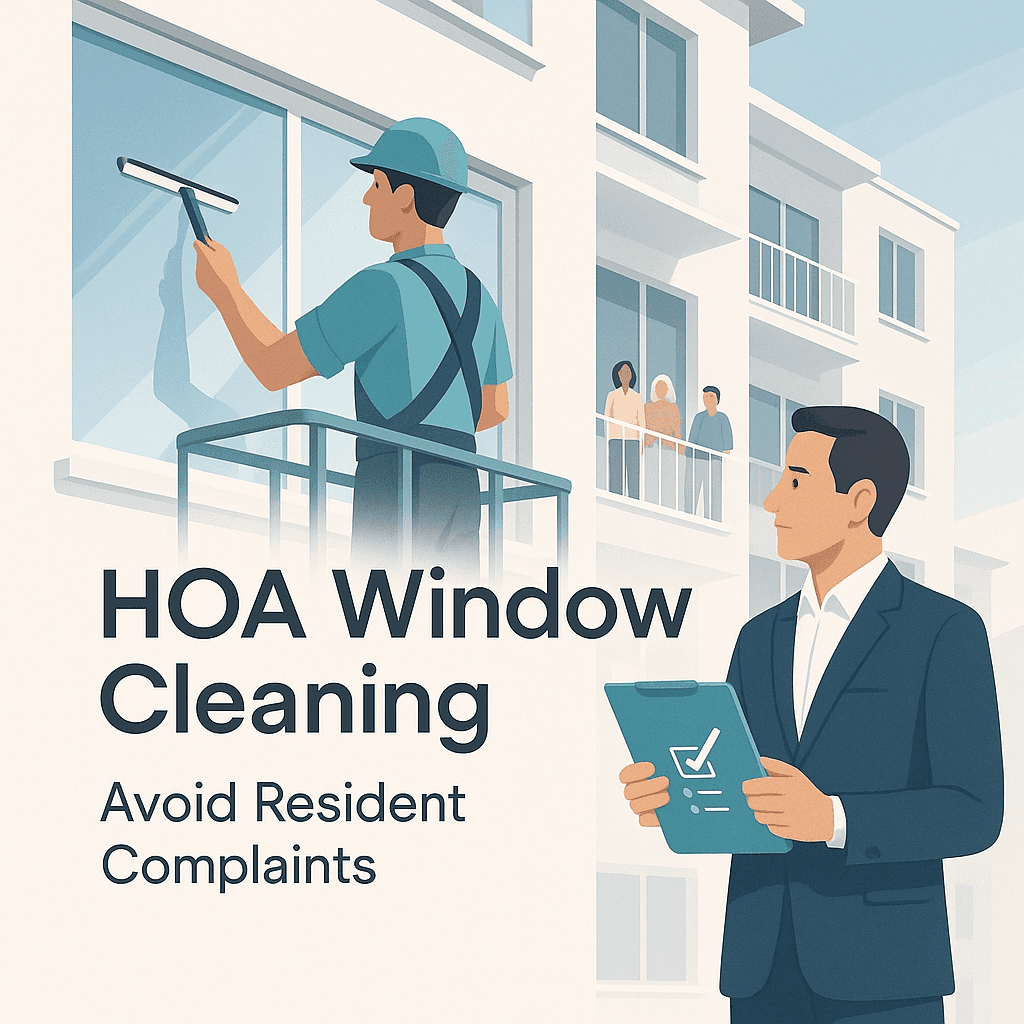
HOA window cleaning sounds simple until you actually do it.
Because in a neighborhood with an HOA, the windows are not just windows. They are a touchy subject. People are working from home. People have babies napping. People have dogs that lose their minds when a ladder touches a wall. And some people will complain because the sky is blue and they had time that day.
So the goal is not just clean glass.
The goal is clean glass with as little friction as possible. No surprises. No wet walkways. No “why is someone looking in my living room” emails. No angry calls to the management office. And no residents posting blurry photos in the Facebook group like it is a crime scene.
This guide is basically the playbook. If you are an HOA board member, a property manager, or the contractor handling the work, this is how you prevent the most common resident complaints before they happen.

Why residents complain about window cleaning (even when the windows look great)
Most complaints are not really about the cleaning. They are about the experience around the cleaning.
Here is what usually triggers it.
1) Noise at the wrong time
Early morning pressure washer sounds. Buckets clanking. Poles tapping glass. Workers talking loudly between buildings because they are trying to coordinate. These disturbances can be particularly frustrating for residents who value peace and quiet, such as those working from home or those with sleeping infants. It’s essential to manage noise levels during these sensitive times to avoid complaints about noisy neighbors.
2) Privacy and “someone is staring into my unit”
Even if nobody is trying to look inside, residents feel exposed when a technician is on a ladder near a bedroom window. Especially in condos.
3) Drips, overspray, wet sidewalks, slippery entries
Water trails on stucco. Soap spots on railings. Puddles near stairwells. It does not take much for someone to call it a safety hazard.
4) Mess left behind
Screen debris. Cobwebs. A few leaves pushed into a corner. One forgotten bottle cap. People notice.
5) Scheduling confusion
This is the big one. Someone did not get the memo. Someone had guests. Someone has a doctor appointment and does not want noise. Someone works nights and sleeps during the day.
6) Results that do not match expectations
The windows might be technically clean, but if hard water spots remain, or frames still look dusty, residents think “they did nothing.”
So yeah. Complaints are predictable. Which is good news. Predictable means preventable.
Step 1: Get the scope crystal clear before you schedule anything
If you want fewer complaints, start with clarity. Like boring, painfully specific clarity.
Here is what should be decided upfront, in writing:
- Which windows are included (exterior only, or interior too)
- Are sliders included
- Are glass doors included
- Are balcony glass panels included
- Are skylights included
- Are screens included (remove, brush, wash)
- Are tracks and sills included
- Is hard water stain removal included (this is usually a separate line item)
- What buildings are included and what the access rules are
- What hours are allowed by the HOA
If you do not define it, residents will define it for you. And they will define it in the most expensive way possible.
Tip: Put the scope into a one page “What to Expect” sheet. Plain language. No contractor jargon.
Step 2: Communicate like you are overcommunicating (because you are)
You basically need three waves of communication.
Wave 1: The heads up (7 to 14 days out)
This is the announcement. Dates, general hours, what residents need to do (if anything), and who to contact with questions.
Wave 2: The reminder (48 to 72 hours out)
Same info, shorter. People forget. That is normal.
Wave 3: The “we are on site” notice (day of)
This can be a text blast, email, lobby signage, or door hanger depending on the community.
If the HOA has a resident portal, use it. If they use a Facebook group, post there too. If they have building bulletin boards, put signs up. Redundancy is not annoying here. It is protective.
What residents actually want to know:
- Which day their building is scheduled
- What time range
- Whether they need to move patio furniture, close windows, secure pets
- Whether technicians will need balcony access
- Whether purified water poles will be used (less chemicals, less residue)
- What “normal” looks like (a little water on glass during the process is normal)
Here is a simple message that works well:
“Window cleaning is scheduled for Building 3 on Tuesday between 9am and 3pm. Please keep windows closed, secure pets, and remove small items from lanais if possible. Our vendor uses purified water systems to reduce spotting and chemical use. If you have special access needs, contact management before Monday at 12pm.”
That alone eliminates a lot of the angry calls.
Step 3: Choose the right hours, and do not start too early just to “get ahead”
Starting at 7:30am might seem efficient. It is not.
In many HOAs, quiet hours matter, and even if they are not written down, residents still expect them. In Southwest Florida, you also have heat and storms to think about, so the schedule needs to be realistic.
General sweet spot for fewer complaints:
- Start around 9am
- Stop noisy setup by late afternoon
- Avoid holidays, big community events, and heavy move in days
If you are doing multiple buildings, rotate in a way that avoids hitting the same residents early every time.
Step 4: Put privacy first, even if nobody asked
This is a big one in condos, especially when lanais are involved.
A few privacy rules that prevent drama:
- Technicians should announce themselves when entering a lanai area (if access is provided)
- No peeking inside. Sounds obvious, but say it anyway in training
- Avoid pressing faces close to glass
- Use signage: “Window Cleaning In Progress”
- If interior cleaning is included, residents must have opt in scheduling, not surprise entry
If you are a board or manager, require that the vendor’s team is uniformed and clearly identifiable. Random unmarked crews make residents nervous.
Step 5: Use the right method for the community (purified water helps more than people realize)
In Florida, especially coastal areas like Naples, the combination is rough:
- salt air
- sprinklers hitting glass
- hard water mineral deposits
- humidity and pollen
This is where cleaning method matters.
Purified water / water fed pole systems
Purified water cleaning is one of the best ways to reduce residue and spotting because the minerals are removed. It also reduces the need for soaps around landscaping and walkways.
Residents tend to complain less when:
- there is less chemical smell
- there is less dripping soap
- there is less “milky” runoff on stucco
A lot of professional companies now lean on purified water systems for exterior glass for exactly this reason.
If you are in Naples and surrounding communities, Naples Florida Window Cleaning uses purified water systems and eco friendly products, which is basically what many HOAs want anyway. Less mess. Fewer callbacks. Easier to keep residents happy.
Traditional squeegee work
Still great, especially for detail work, storefronts, and certain glass types. But it requires more control around dripping and runoff.
Pressure washing near windows
Be careful. Pressure is not a window cleaning method. It is a building washing method. If you do use pressure washing in the same project, you need a plan for overspray, noise, and protecting residents’ lanais and patio items.
Step 6: Treat screens, tracks, and sills like “complaint magnets”
Residents look at the edges. They do not always look at the middle of the glass.
If screens are left dusty, residents think the windows were not cleaned. If sills have dead bugs, same story. If tracks are full of gunk, they assume the crew rushed.
So even if the contract is “exterior glass only,” consider adding an upgrade line item for:
- screen rinse or screen wash
- quick wipe of accessible sills
- track debris removal
You do not have to do a full deep detail on every track, but some attention here reduces complaints a lot.
Also, if a community has a ton of hard water staining, call it out before you clean. Hard water stain removal is not magic, it takes time, and it is often billed separately. If you do not explain that, the resident will assume you missed spots.
Step 7: Have a real plan for cars, walkways, and landscaping
This is where most “mess” complaints come from.
A simple on-site plan looks like this:
- Cones or small signs near active work zones to ensure safety, similar to the guidelines in this work zone safety resource.
- Technicians route hoses safely, not across stairwells without protection
- Rinse down any overspray on railings and walkways immediately
- Do not leave buckets where people walk dogs
- Watch for sprinkler cycles and avoid cleaning right before sprinklers kick on
If you are a property manager, ask the vendor if they do a final walkthrough. It is a small thing, but it prevents that one resident from emailing a photo of a puddle like it is a lawsuit.
Step 8: Make it ridiculously easy for residents to report an issue (without blasting the whole HOA)
If residents do not know where to report an issue, they will report it everywhere.
They will email the board, the manager, the front desk, and also post it online. Now it is public. Now it is emotional. Now it is bigger than it needed to be.
Instead:
- Give residents one email and one phone number
- Set a simple rule: report within 48 hours for fastest touch ups
- Have the vendor commit to a quick callback window
Even better, give residents a tiny checklist of what is worth reporting:
- missed window section
- new streaks after drying
- screen reinstalled incorrectly
- access issue or technician conduct
This keeps the feedback useful and manageable. If there’s an issue with your hospital or any other service provider, consider following some of these reporting strategies to get results effectively.
Step 9: Document before, during, and after (because someone will swear you damaged something)
In HOAs, there is always a “that crack was not there before” moment.
Basic documentation that helps:
- Photos of any existing cracked panes, failed seals, or damaged screens
- Notes on hard water stains that will not come out with standard cleaning
- Work logs by building and date
You do not need to be paranoid. Just organized.
Step 10: Do a small pilot first if the community is sensitive
If you have had complaints in the past, do not start with the whole property. Instead, consider implementing a small pilot program first.
Start with one building. Or one courtyard section. Let residents see how it goes. Tune the process. Then roll it out.
This also helps you answer resident questions with real examples:
- “Will it drip everywhere?”
- “Are they using chemicals?”
- “How long does it take per building?”
Now you can say, “We tested it last week. Here is what to expect.” That calms people down.
A quick HOA window cleaning checklist (the non dramatic version)
Use this as your pre job checklist.
- Scope defined (glass, screens, tracks, stains)
- Dates and building order confirmed
- Quiet hours and access rules confirmed
- 3 wave communication plan scheduled
- On site signage printed
- Privacy expectations shared with crew
- Safety plan for hoses, walkways, lanais
- Touch up policy and resident contact method set
- Documentation plan (photos, notes)
- Final walkthrough included
If you are in Naples, here is the “easy button” approach
If you are managing an HOA or condo community in Naples or nearby Southwest Florida, you want a vendor who already understands the common friction points. Scheduling, privacy, water quality, hard water staining, all of it.
Naples Florida Window Cleaning offers residential and commercial window washing with purified water systems, eco friendly products, and insured technicians. They also handle add ons that HOAs often need like screen cleaning, track and sill cleaning, and hard water stain removal.
If you want to reduce resident complaints, a lot of it comes down to choosing a team that does not create extra problems while solving the main one.
You can check services or request a quote here:
https://naplesflwindowcleaning.com/
Wrap up (because this stuff is not complicated, it is just easy to mess up)
HOA window cleaning goes wrong when people treat it like a normal house job.
It is not.
It is dozens or hundreds of residents sharing space, routines, expectations, and patience levels. If you make the experience predictable, clean, and respectful, complaints drop fast. Not to zero, probably never zero. But low enough that everyone stops talking about it. Which is the real win.
Clear scope. Tight communication. Privacy rules. Smart scheduling. Clean methods like purified water. A simple touch up process.
Do those things and the windows get cleaned. And your phone stays quiet.
FAQs (Frequently Asked Questions)
Why do residents often complain about HOA window cleaning even when the windows look clean?
Most complaints stem not from the cleaning quality but from the experience around it, such as noise disturbances, privacy concerns, wet walkways, mess left behind, scheduling confusion, and results that don’t meet expectations. Understanding these triggers helps in preventing complaints.
What should be clearly defined before scheduling HOA window cleaning to minimize resident complaints?
It’s essential to have a crystal clear scope in writing that specifies which windows and areas are included (exterior, interior, sliders, glass doors, balcony panels, skylights), whether screens and tracks are cleaned, if hard water stain removal is included, which buildings are involved with access rules, and allowed working hours by the HOA.
How should communication be handled to reduce complaints during HOA window cleaning?
Overcommunication is key with three waves of communication: 1) A heads-up 7-14 days before with dates and instructions; 2) A reminder 48-72 hours prior; 3) A day-of notice via texts, emails, door hangers or community boards. Messages should include schedule details, preparation steps for residents (like securing pets), and what to expect during cleaning.
What are some best practices for scheduling HOA window cleaning to avoid resident issues?
Avoid early starts like 7:30am to respect quiet hours—starting around 9am is ideal. Stop noisy activities by late afternoon. Avoid holidays, major community events, and busy move-in days. Consider local climate factors like heat and storms when setting schedules.
How can privacy concerns be addressed during HOA window cleaning?
Technicians should be mindful when working near windows to avoid making residents feel exposed. Clear communication about when and where cleaners will work helps residents prepare. Using purified water poles reduces chemical use and residue that might otherwise require closer inspection inside units.
What steps can contractors take to ensure minimal mess and safety hazards during HOA window cleaning?
Contractors should prevent drips and overspray on stucco or railings, avoid puddles near stairwells that create slippery entries, thoroughly clean up screen debris and cobwebs after work, and ensure no trash or forgotten items are left behind. This attention to detail reduces resident complaints about hazards or messes.